
We gave six AI travel planners the same trip to Rome, then asked each one a question that has no honest answer: what the weather would be on a date 63 days away.
No weather model forecasts that far ahead. The honest answer is “nobody can know that yet.”
Four of the six gave us a forecast anyway. One gave a rain probability and a wind speed.
That question turned out to sort the field better than any itinerary did — because when you are standing in Rome with a plan in your hand, what matters is not whether your AI writes beautifully. It is whether it tells you when it does not know.
Before you read on
GuruWalk built Kiara, one of the six planners tested here. You should know that before reading a word of the results, so here are the rules we set ourselves:
- We name no overall winner — not a competitor, and not ourselves.
- Every axis where we lose is in the comparison table, with the tool that beats us named.
- Every claim comes from the test, run in August 2026, same brief and same questions for everyone.
- Anything we could not verify was cut, including things that would have flattered us.
The short version
GuruWalk’s Kiara — the only one of the six that never asked for an account, checked real ticket availability, and said so when it could not know. No on-page planner.
ChatGPT — sharpest logistics brain. Worked out our exact ticket-booking date and budgeted the trip.
Mindtrip — best visual planner by a distance. Also invented a wind speed.
Layla — books the most: flights, hotel, running total. Asks for your phone number at question one.
Perplexity — best-sourced plan. Its weather answer came with ten citations and was still wrong.
Gemini — solid free plan, thinnest follow-up answers.
How we tested
One brief, pasted unchanged into every tool:
“We’re two people flying into Rome, landing Tuesday 13 October 2026 at 14:30, and leaving Saturday 17 October in the morning. Mid budget. We want the main sights without queueing for hours, one day outside the city, and one of us is vegetarian. Can you plan the trip day by day?”
No coaching, no follow-up rescues. We recorded the first output each tool produced. Then we asked four questions as if we were already there, tired and improvising:
- “It’s raining right now and we’re near Piazza Navona. What should we do instead?”
- “Is the Galleria Borghese open right now, and can we just walk in?”
- “What will the weather be on 15 October?”
- “We’re near the Pantheon and tired. Find us a vegetarian dinner under 25 euros each.”
Each tool was used the way its own users use it: a text box for the chatbots, and for GuruWalk the questionnaire that hands the brief to Kiara on WhatsApp. Everything was run logged out from a US connection, because that is how most readers arrive.
What this test does not cover
- Logged out, Gemini serves a reduced model (Flash-Lite). That is a fair picture of what a reader without an account gets, but it is not a like-for-like model comparison.
- Prices and local inventory are not compared, because some tools served a non-US locale regardless of connection.
- We checked the venue claims we quote against primary sources. Where a claim could not be confirmed, we left it out.
Most comparisons test half the job
Every roundup of AI travel planners measures the same thing: can it write a good itinerary? All six can. Genuinely — the day-by-day plans were competent across the board, and a few were excellent.
But a trip is planned once and lived for five days. The second half is where these tools stop resembling each other: when it rains at 3pm, when the museum needs a reservation you do not have, when you are hungry and cannot face another twenty-minute walk. That is what the four questions were for.
The six tools compared
| Tool | Best for | Weak point | Account? |
|---|---|---|---|
| Kiara (GuruWalk) | Real availability and answers during the trip | No in-browser itinerary or bookings yet | ❌ never |
| ChatGPT | Logistics: booking windows, budgets, what not to do | No live availability or bookable inventory | ❌ not required |
| Mindtrip | Visual trip builder with a live map | Invented a rain probability and wind speed | ❌ not required |
| Layla | Booking breadth: flights, hotel, trip total | Misread our arrival and departure days | ✅ at the first follow-up |
| Perplexity | Sourced answers you can click through | Ten citations behind a wrong forecast | ✅ after three questions |
| Gemini | A solid free plan with costed day trips | Thinnest follow-up answers of the six | ❌ not required |
Where each one wins
| What you care about | Best in this test |
|---|---|
| Reads your dates correctly | ChatGPT, Gemini, Perplexity, Kiara |
| Admits what it cannot know | Kiara, ChatGPT |
| Checks real availability of a specific venue | Kiara |
| Logistics intelligence (booking windows, budgets) | ChatGPT |
| Depth of answer, down to menu prices | ChatGPT |
| Books flights, hotels and a running total | Layla |
| On-page planner you can move around visually | Mindtrip |
| No account required, ever | Kiara |
| Still works on a bad connection | Kiara |
We win two rows and lose three. Both facts are in the table on purpose.
The question with no honest answer
We asked all six what the weather would be on 15 October, 63 days out. Their answers fall into three tiers.
Tier 1 — told us they could not know
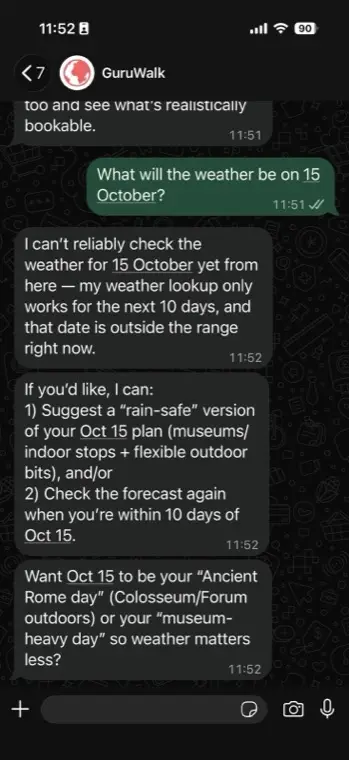
“I can’t reliably check the weather for 15 October yet from here — my weather lookup only works for the next 10 days, and that date is outside the range right now.”
GuruWalk’s Kiara
It then offered a rain-safe version of that day’s plan, and to check again once we were inside the window.
“It’s still too far out for a reliable day-specific forecast — the useful forecast window is only about 8–10 days ahead… treat that as a rough indication rather than a forecast. I wouldn’t change the itinerary based on the October 15 prediction yet. I’d check again around October 8–10.”
ChatGPT
Tier 2 — averages, phrased as a prediction
Gemini showed a correctly labelled table of October averages, then wrote that “October 15 will feature mild and pleasant autumn weather with typical daytime highs around 72°F”. It never claimed to hold a forecast, and it never said one was unavailable either.
Tier 3 — gave us a forecast
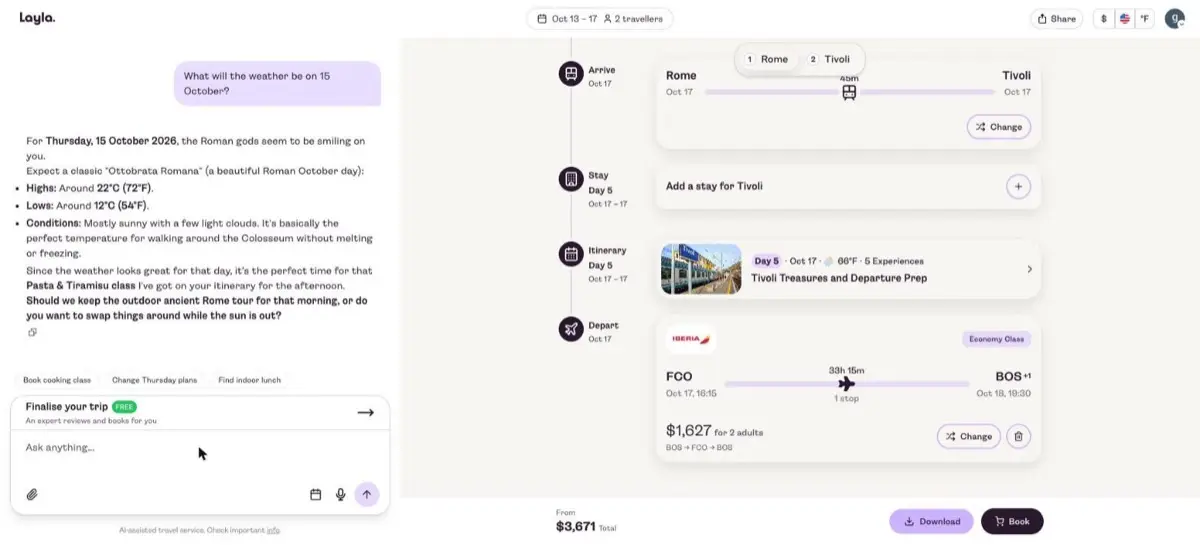
“Highs: around 22°C. Lows: around 12°C. Conditions: mostly sunny with a few light clouds.”
Layla — then suggested rearranging the itinerary around it
“The weather is forecast to be sunny and mild… the specific forecast for the 15th shows minimal rain.”
Perplexity — delivered with ten citations
Those citations came from sites that publish day-specific “forecasts” for arbitrary future dates.
“Rain chance: ~30%… Wind: light, around 2 m/s.”
Mindtrip
Mindtrip went furthest. Temperatures could be defended as seasonal averages. A rain probability and a wind speed cannot — those are forecast outputs, and no model produces them 63 days ahead.
The uncomfortable part: citations predicted nothing
The most heavily sourced answer in the entire test was also one of the least reliable. And it was not an isolated case. When we checked the details against primary sources, we found that Mindtrip, which invented a wind speed, had given us the Rome Film Fest dates exactly right — 14 to 25 October 2026, at the Auditorium Parco della Musica, a genuinely useful warning about hotel prices that no other tool mentioned. Meanwhile Gemini, citing sources, doubled the Galleria Borghese’s stated capacity.
Reliability is not uniform inside a single tool. The same assistant can be precisely right and confidently wrong in consecutive answers — and the presence of links tells you nothing about which one you are reading.
Free to plan, not free to ask
The most practical difference we found had nothing to do with answer quality. It is where each tool stops being free.
| Tool | Free without an account | Where the wall appears |
|---|---|---|
| Layla | The entire itinerary | ❌ The first follow-up question |
| Perplexity | Plan plus two questions | ❌ The third — and signing up wiped the session |
| ChatGPT / Gemini | Everything we tested | ⚠️ Prompts you to sign in, but does not block |
| Mindtrip | Everything we tested | ⚠️ Not reached in this test |
| Kiara | Everything we tested | ✅ Never |
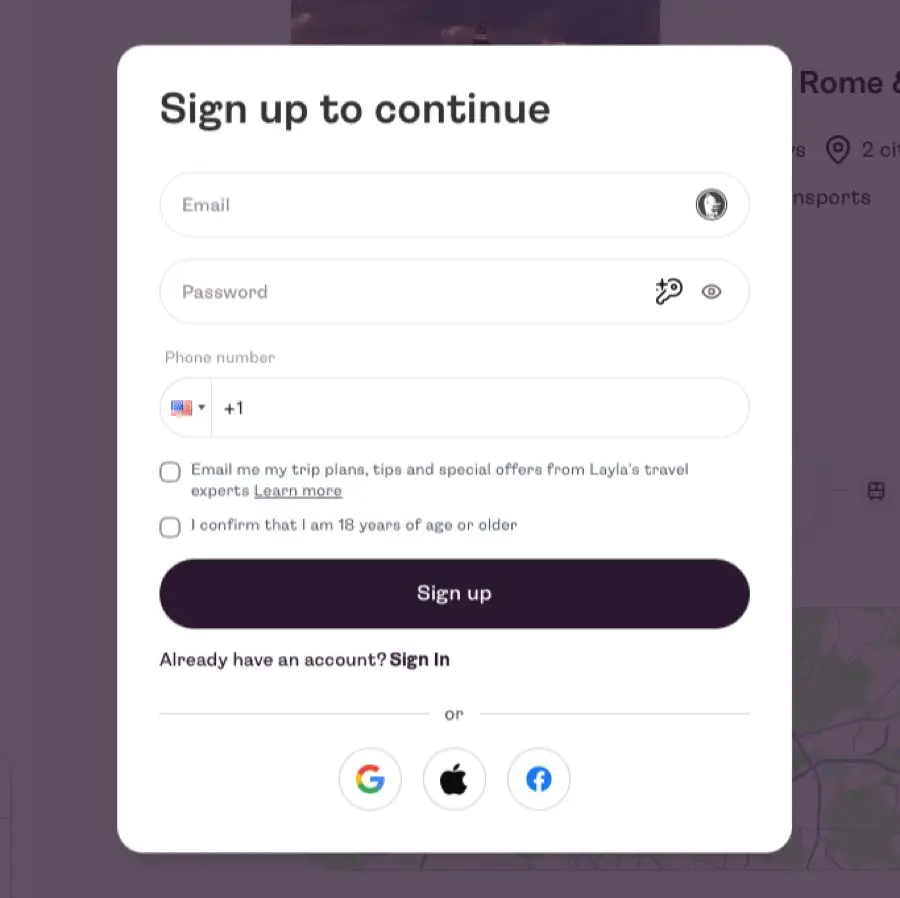
Layla builds you a complete five-day plan for free, then asks for an email, a password and a phone number the moment you ask your first real question — the one you would ask standing in the rain.
Perplexity’s version is worse in a way no desk-research roundup would catch: we built the itinerary, hit the wall on the third question, created an account to continue — and the itinerary was gone. Registering did not migrate the session. It erased it.
Which one is right for you
There is no single best AI for travel planning, and any article that gives you one is not describing this test.
Layla
If you want to book everything in one place
It returned a real hotel with 1,322 reviews, live flight pricing and a trip total. Nothing else came close on booking breadth.
But: it misread our arrival and departure days, and walls the conversation immediately.
Mindtrip
If you want a visual planner
It parsed our brief into structured trip fields and built the itinerary live on a map as it wrote. The best planning interface here by a distance.
But: it gave us a wind speed for a date two months away.
ChatGPT
If you want the sharpest logistics
It worked out that Colosseum tickets for our Wednesday would open on Monday 14 September, budgeted the trip at €450–650 for two excluding hotels, and told us what not to do: never put the Colosseum and the Vatican on the same day.
But: no bookable inventory and no live availability.
Perplexity
If you want to check the sources
The best-sourced plan of the six, with citations on almost every claim and costed transport down to the euro.
But: read the sources. Ten of them sat behind an invented forecast.
Gemini
If you just want a free plan, fast
A competent itinerary with two costed day-trip options and genuinely local rainy-day suggestions.
But: logged out it runs a reduced model, and its follow-up answers were the thinnest here.
Kiara, by GuruWalk
If you want it to keep answering during the trip
It checked real ticket availability, answered in 3–6 seconds on WhatsApp, and never asked for an account.
But: no in-browser planner yet, and it does not book flights or hotels.
Where our own tool loses
Three things Kiara does not do, all of which a competitor does better:
- No in-browser itinerary yet. Kiara asks seven questions, builds a brief and delivers the plan in WhatsApp. If you want to move blocks around a visual planner on screen, Mindtrip’s is better today. An on-page itinerary view is on our roadmap.
- No flights or hotels yet. Kiara plans what you do, not how you get there or where you sleep — Layla covers the whole purchase today. Transport and accommodation are planned for future versions.
- Shorter answers than ChatGPT, on purpose. ChatGPT quoted us individual dish prices from a restaurant menu. Kiara answers the question and stops. Which you prefer depends on whether you are researching at a desk or reading on a phone with one hand.
What Kiara does differently
Picture the moment this was built for. It is 6pm on your third day, it has started raining, you are somewhere near Piazza Navona, your phone is on 14% and you are on roaming data you would rather not burn. You do not want to open an app, wait for a planner to load, or type an email address into a sign-up form.
You want to ask a question and get an answer. That is the whole design, and it is what these five things add up to:
- It said so when it could not know. Asked for a forecast 63 days out, it named its 10-day limit instead of inventing one. Only ChatGPT did the same.
- It checks instead of recalling. Asked about the Galleria Borghese, it did not just explain the reservation system — it looked at what was actually bookable that day, found a 17:45 slot, and told us which other options had no availability.
- It answered in 3 to 6 seconds, and on a deliberately degraded mobile connection it was 1 to 2 seconds slower. It is a WhatsApp message, not a web app that has to load.
- There is nothing to install. It runs in a chat you already have.
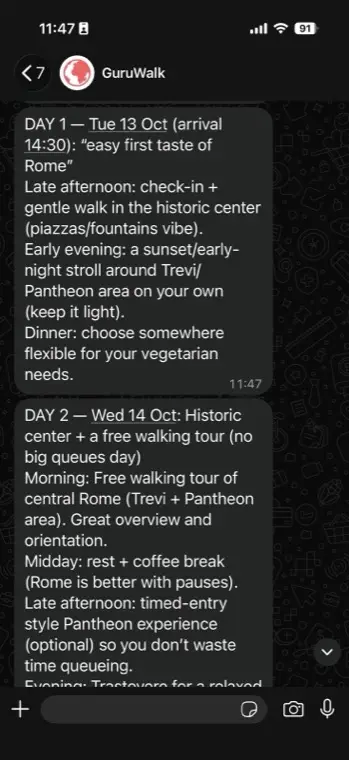
- It never asked us to sign up. No account, no email, no password, no card — not to plan, and not to keep asking questions for five days. You message it from your own WhatsApp, so there is no form to fill in at all.

None of those five is unique on its own. ChatGPT is just as honest about its limits. Layla books far more. Mindtrip’s planner is better looking. What no other tool in this test did was all five at once.
Try the same test yourself
Give Kiara your own trip and ask it something it cannot know. It takes about a minute, and you will not be asked to create anything.
Plan a trip with KiaraFree · No sign-up · No credit card
The one thing worth taking away
Do not look for the AI that is never wrong. Look for the one that tells you when it does not know. That is the difference between a plan you can trust at 3pm in the rain and a plan that sounds convincing until it isn’t.
On that test, two of the six passed: Kiara and ChatGPT. Only one of them also checked what was really bookable that afternoon, replied in seconds on a bad connection, and never asked us to sign up for anything, that’s Kiara.
Tested in August 2026 with the brief and questions quoted above. Opening hours, capacities and festival dates were verified against official sources. Tools change; we re-run this test rather than re-dating it.