Glasgow Walking Tour
Best walking tours in Glasgow with local guides:
 Guru:
 Guru:
 Guru:
Last update:
Discover More With Glasgow Free Walking Tour Abroad
- Edinburgh walking tours
- Dublin walking tours
- London walking tours
- Amsterdam walking tours
- Paris walking tours
- Free Walking Tour Copenhagen
- Free Walking Tour Berlin
- Free walking tour Munich
- Free walking tour in Prague
- Belfast free walking tour
- Liverpool free walking tour
- Manchester free walking tour
- Free walking tour in Galway
- Free walking tour in Cork
- Free walking tour in The Hague
- Bruges free walking tour
- Rotterdam walking tour
- Free walking tour in Ghent
- Free walking tour in Bergen
- Free walking tour in Lille
Glasgow's free tours from George Square
A free walking tour in Glasgow costs nothing to book on GuruWalk and needs no credit card. When the walk ends, each person tips the guide what they think is fair.
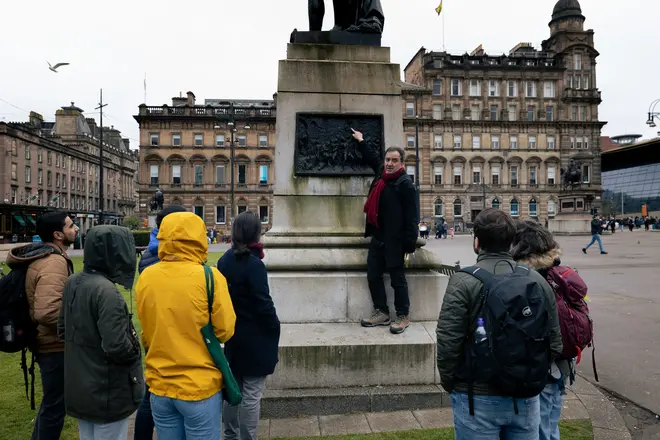
George Square is where many of them meet. From there the walks turn to the city's history, from its merchants and the City Chambers to the Tolbooth Steeple, on a typical route of about three kilometres. 3 local guides lead Glasgow's free tours, and a walk lasts two hours on average. More than 3,586 reviews give Glasgow's free tours an average of 4.8 out of 5.
Merchants, mysteries and the Tolbooth: Glasgow's history walks
Glasgow's history from George Square to the Tolbooth Steeple
Glasgow's history tours keep returning to the merchants who transformed the city in the 18th century, from the Merchants House to the Tobacco Merchant's House, and walkers rate them 4.8 out of 5 in 3,605 reviews. The stop the recorded routes share is the Tolbooth Steeple, part of the original council chambers, dating back to the 14th century. One route crosses the city centre from George Square to the Necropolis and Glasgow Cathedral. Only then does it reach the Mercat Cross and the Tolbooth. Another takes the darker, more secret side of the city, from the Tolbooth along Trongate to James Watt's workshop and Virginia Court.
From George Square past the St Mungo murals to the Necropolis: Glasgow on foot
A walking tour of Glasgow covers about three kilometres on a typical route and takes an hour and a half to two and a half hours, often setting out from George Square. There is no fixed route, and few stops beyond the Tolbooth Steeple are shared. One of the routes, from George Square through the city centre to the cathedral and on to the Tolbooth, runs like this:
- George Square, where many walks meet, followed by the Merchants House, the G1 Building, which opened in 1878 as the General Post Office, and the Walter Scott Monument.
- Glasgow City Chambers, opened in 1888, with sculptures on the outside that tell the history of the city.
- John Street, under the arches that join the City Chambers to their 1912 extension.
- University of Strathclyde, whose Royal College Building was the largest technical college in Europe when it opened in 1903.
- The St Mungo murals, including St Enoch cradling a young St Mungo, Glasgow's patron saint.
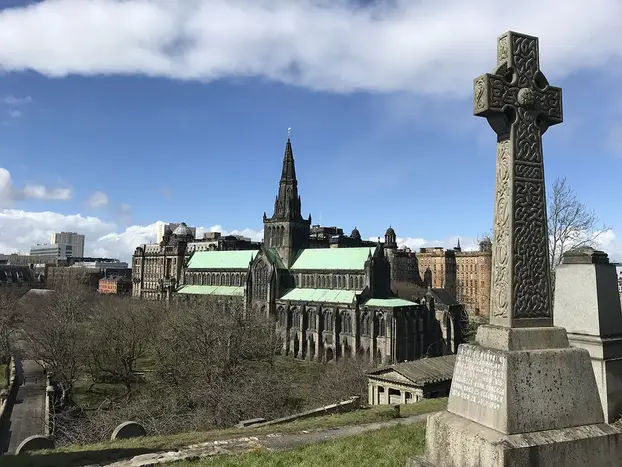
- Glasgow Necropolis and Glasgow Cathedral.
- Mercat Cross and the Tolbooth Steeple, part of the original council chambers, dating back to the 14th century.
- Ramshorn Graveyard, where some walks end, after the Tron Theatre.
Another route leaves George Square along Buchanan Street, past the Duke of Wellington statue and the Tobacco Merchant's House, to the Tolbooth Steeple and Trongate, then on to Hutchesons Hall, the City Halls and Old Fruitmarket, James Watt's workshop and Virginia Court.
What Glasgow walkers ask before setting off from George Square
Is the Glasgow guide's pay up to you?
Free tours in Glasgow don't have a fixed price. At the end, each person contributes to the guide the amount they consider fair based on their satisfaction. As a guideline, GuruWalk recommends between €15 and €50 per participant.
How much time does a Glasgow history walk take?
Glasgow's walks run from an hour and a half to two and a half hours, two hours on average. A typical route covers about three kilometres of the city centre.
Glasgow's first and last walks: at what time?
Glasgow's earliest walk this November sets off at 10:30 AM, and the latest at 1:30 PM. Most are in English (three), with one each in Spanish and Italian, so check the language and the time of each tour when you book.
Does every Glasgow walk start in George Square?
Not every one, but many do: George Square is a meeting point for several Glasgow walks, and some start on South Frederick Street. The meeting point of each tour is shown when you book.
St Mungo murals and the Necropolis: is a guide needed?
Not to find them: in Glasgow you can reach George Square, the St Mungo murals and the Necropolis on your own. A guide, free to book, gives the statues, murals and merchants' houses their stories, like the tradition around the James Oswald statue. Groups have limited places, so book ahead.
Frequently asked questions about free walking tours in Glasgow
How much should I tip at the end of a free walking tour in Glasgow?
A typical free tip is between £10 and £20 per person, with the median sitting around £10 to £15. Cash is welcome but most Glasgow tours also accept card payments. Several guides accept euros if you don't have pounds. If anyone asks for a fixed payment at the end, it's no longer a free tour.
How long does a free walking tour in Glasgow last?
City centre and essential tours usually run between 2 hours and 2 hours and a half. Old Town routes around the Cathedral and Necropolis sit in the same range, while West End walks tend to be slightly shorter, around 1 hour and a half to 2 hours.
Do I need to book in advance?
Yes. The tour is free at the start but groups are limited and fill up fast on weekends, festivals (West End Festival, Celtic Connections) and during summer. Booking online secures your spot and lets the guide plan the route accordingly.
Where are the usual meeting points?
Most tours start at George Square, often near the Lion sculptures or the Cenotaph. Routes focused on the Old Town may begin near Glasgow Cathedral; West End walks usually start by the University of Glasgow or Kelvingrove. The exact spot and the guide's identifier (umbrella or jacket colour) come in your booking confirmation.
What happens if it rains during the tour?
Glasgow rains often. Tours run anyway unless conditions are severe; guides carry umbrellas and know covered stretches when the weather turns. Bring a waterproof jacket and shoes with grip for the wet pavement. There are pubs and cafés along most routes for a quick dry stop if needed.
Does the tour include entry to Glasgow Cathedral or the museums?
Free walking tours run outdoors, but Glasgow stands out because most of its main attractions are free to enter on their own: Glasgow Cathedral, the Kelvingrove Art Gallery, the People's Palace and the Riverside Museum all have free admission. The Necropolis is open ground and free to walk through. Around 8 in 10 routes are marked as accessible for visitors with reduced mobility, although hilly stretches near the Cathedral and Necropolis are steep.
Our tour guides in Glasgow